

How To Draw Different Textures With Pencil

No one taught me how to draw texture, I discovered by trial and fault. Dorsum in the twenty-four hours, in that location were no online lessons, simply books, and virtually were useless. It'southward not much better at present, and that's why this mail will help yous go results faster.
Drawing texture is easier using B-form pencils on grainy newspaper. Use erasers to lift-out textures by dabbing. Sketch fur and hair in the direction of growth and employ your eraser to swipe the highlights.
There is a lot to comprehend and this post is an overview of techniques to get you started. Equally with everything else to exercise with drawing, goose egg beats practice. And then with that in mind let's get going.
(I get commissions for purchases made through links in this post. Withal, I only promote products I similar and recommend)
1. How to Draw the Texture of Rock
If you lot want to show off and astonish people with your skill, there is nothing easier than cartoon rocks and stones. It's then like shooting fish in a barrel to depict texture, it'due south about cheating.
Information technology was while I was playing around with graphite stumps and Blu Tack (chapter links) that I realized the potential to brand upwardly rock texture without always having to copy it.

Here's a instance in point. This leopard was in the Singapore Zoo and that rock was actually concrete. The form and shapes were easy enough to draw. In that location are but 3 uncomplicated blocks with some basic shadows on the left. The calorie-free is coming from the right.
I shaded the rocks initially using a 0.3mm HB Pentel Mechanical Pencil (affiliate). If I had used a 0.v or 0.7mm the grain would've been much coarser. I wanted a gentler texture so 0.3mm was fine. I didn't attempt to draw detail at this stage.
If yous need assist with pencil grades read: What Do Pencil Numbers Hateful? Pencil Grades Explained + Charts
When everything was blocked in I took a small ball of clean Blu Tack (affiliate) and rolled it at random beyond the bottom left. The graphite lifted off in a patchy blueprint.
I refined the patches by redrawing the lost shadows and calculation darker edges. Now the blotches stood out as slightly raised from the base. I could envisage some natural-looking cracks and fissures and I exaggerated them for a iii-D effect.
Information technology'due south all serendipity. I made marks and capitalized on the random effect. Information technology could've gone wrong, in which case I'd accept shaded over the mistake and tried again. Nothing lost.
Having got the assuming low-cal and cracks looking proficient, I pressed a indicate of Blu Tack (affiliate) onto the paper to create further texture. You can run across how I lifted more on the right side of the leopard.
I picked out whatever anomalies in the paper where the grain looked interesting and dabbed out the lighter patches. These pocket-sized raised patches expect very real. I could raise or soften them at volition with shading.
The cracks look real because the darks are bordered by lighter edges. Look closely at the primal slab, the crack on the left has a low-cal reflection along the edge. That makes the rock expect much more rounded.
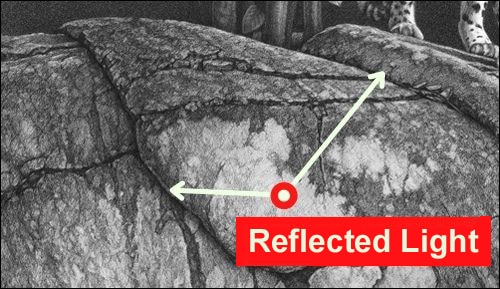
The rock on the top right just below the leopard is shaded lighter in the middle and darker on the ridge. It's a soft and uneven transition. a more solid shadow would look less convincing.
There is some other way of cartoon rock texture or boulders.
Describe a boulder shape and decide the direction of the calorie-free. Now take a 6B graphite stump (affiliate) and drag it randomly across the surface, twisting it as you do then. You lot will create very grainy speckled spots and rings.
Join some of the spots and rings with a sharp 3B and strengthen some patches with some shadow. Before y'all know it, you'll accept an insane corporeality of particular that looks like information technology took forever, but in fact, information technology took minutes.
2. How to Draw the Texture of Tree Bark
I depict bark texture in a similar mode to rock merely with more finesse. Information technology is all about lifting off texture with Blu Tack or a Kneadable Eraser (affiliate links)
This leopard cub in a tree is a good example of bark that was drawn with good technique rather than trying to re-create information technology exactly.

The bark on the tree trunk is a series of random elongated shapes following the line of the tree. I didn't endeavour to copy them, in that location was no demand, all I had to do is create the same impression.
I shaded the tree with a 0.3mm B grade mechanical pencil and darkened both sides. The light is coming from behind the viewer.
And then using a Tombo Mono Eraser Pen (affiliate) I dragged information technology down the trunk in random crossing broken lines. The bark shapes in the center are wider than those on the sides. It's a subtle gesture and gives the illusion of a curve in the trunk.
I had to exist careful because I wanted to retain the crispness of the bark texture. I didn't want to lose the speckled grain by smudging the surface.
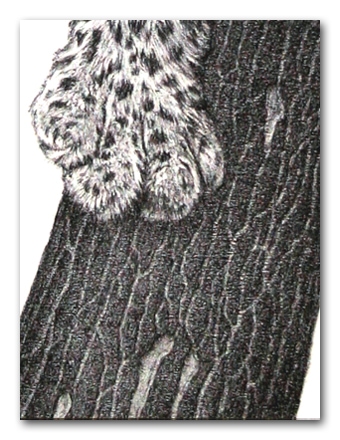
With the random shapes marked down I could shade 1 side of each piece of bark to make them 3D.
The shadows on the right, are all on the right, and on the other side, they're all on the left. That's because the calorie-free is coming from behind me.
To create depth, I've outlined each piece of bark with a dark line where the shadow meets the light grove. Notation that are no very precipitous lines.
These are great tips: How to Create Depth in Your Cartoon: seven Expert Techniques
Where I've removed some bark, I have erased the mid-tone. I've lightened the edges to the right and darkened the edges on the left side.
The smaller tree limbs are smoother in texture, but you tin can see how I've drawn gashes and wounds into the bark past using the same high contrast technique. They are dark lines with white ridges, for desire of a improve way to describe them.
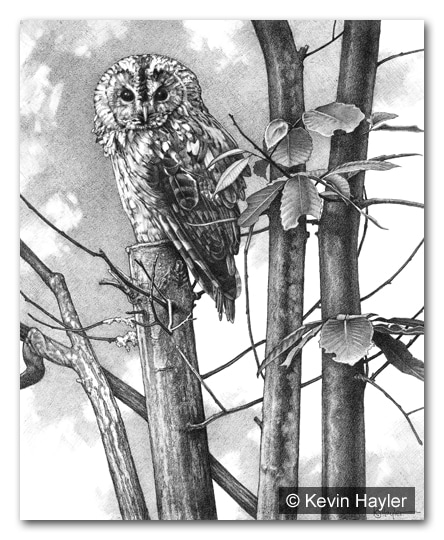
Y'all can see the same technique in this cartoon of a tawny owl sitting in a tree. The highlights and lighter patches forth the main trunks were lifted out by gently brushing with them with a Kneadable Eraser (affiliate)
The scaley patches on the left branch were created by pinching the putty eraser and rolling it along the stem. I drew effectually the marks and created the crusty texture.
iii. How to Depict Textured Backgrounds
I find drawing textured backgrounds quite challenging, and that'due south because I have a tendency to obsess with particular and produce tight drawings. This habit conflicts with drawing in a loose and interesting way, hence my backgrounds can appear stilted.
The two styles are so at odds that they are difficult to combine.
Ideally, I should sketch the background kickoff. This almost never happens. I spend days on the detail and try to add a textured background at the end, by which time, I'm so agape of ruining the drawing I tin can't risk whatever flourishes.
I know what I should do. I should block in all the tonal work and cover the whole moving-picture show from the starting time. I should flip between areas and build up every expanse of the drawing in gradual stages. I should never add together item besides early.
It'south a error to distract myself with detail early on, and I know it's a error fifty-fifty as I succumb to weakness and do information technology anyway!
Drawing a sketchy background is only practical when it's laid down in the sketchy stage. To backtrack, as I tend to do, not merely takes more than time, only it also tends to look less assured. I stop upwardly contriving the spontaneity with varying degrees of success.
Effort these hacks: How to Make Your Drawings Interesting: 14 Ways to Meliorate a Drawing
The Tawny Owl above has a shady background but information technology's a perfect example of adding the background as an afterthought. I drew a very smooth and controlled tone and erased the edges with a kneadable eraser to give the impression that it was random – it wasn't.
I shaded and erased several times before settling on the final expect. Even at present I wait at it with disappointment.
I drew another owl and once more the textured background was far also timid. In the finish, I was so annoyed that I drew over it.

My textured backgrounds are usually made by cross-hatching. It'south random but within a prepare of guidelines. Y'all tin can come across the hatching lines and how they criss-cross. I like to vary the angles and draw each patch next.
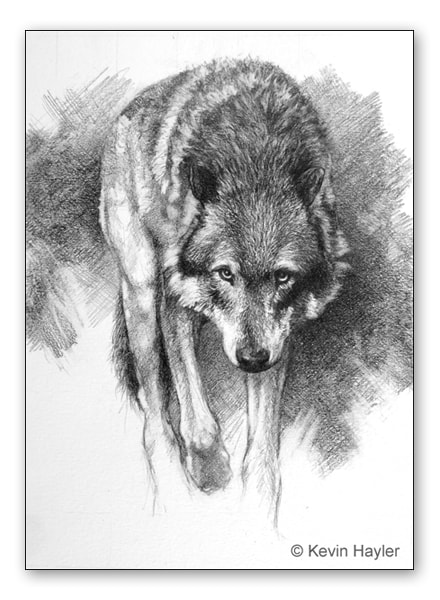
The wolf drawing above is far more successful. The shading has life. The technique was the same but this time I managed to refrain from drawing everything in detail. The event is far more than pleasing to the eye.
The hatching is textured with eraser dabs plus a few swipes to break up the edges.
I can take cross-hatching to the extreme and use it to lay a super apartment blackness groundwork. Very few artists use this technique. Information technology'south fourth dimension-consuming just the silky speckled texture is wonderful.
I apply cartridge paper taped to a very difficult surface. I have an acrylic plastic sheet. You must accept a difficult back up to bring out the paper texture.
I utilize a 0.3mm Pentel Mechanical Pencil (affiliate)
If you are not using these already: Can Y'all Draw With Mechanical Pencils? Yeah, and Here's How
Starting on ane side, hatch diagonally in one direction beyond the paper in one continuous tone. It doesn't matter if at that place are some anomalies because they will go covered up as you get back in the opposite direction.
Start with an HB or B and get back and forth, in layers, until yous reach the darkest tone. Do not press difficult. If the tone is even so non night plenty go over it once again with a 2B.
Any blotchy errors along the way can exist corrected past brushing the surface with a stringy strand of Blu-Tak. Only enough graphite will lift to smooth the blemish abroad and make information technology disappear.

This takes time and a very steady mitt. Well-nigh people will get too frustrated and give up, merely if you lot have the patience you lot will create a textured blackness groundwork that has 'zing'. At that place is no other way to describe texture with that speckled effect.
One last style to draw texture is to shade a background surface area with a soft pencil, something like a 6B, and erase it over again with a Kneadable Eraser (affiliate). It volition not remove all the graphite. The grainy stain will remain, specially around the edges of your detailed drawing.
Information technology gives your cartoon atmosphere.
Hey, if this post is useful, have you ever thought of turning your hobby into a concern? This guide will show you how.

If You Want to Sell Your Fine art
Check this out!
Psst…it's only $12.99!
four. Drawing Grass Textures
I use two methods to draw grass texture, in-focus, and out-of-focus. The out-of-focus method gets the most reaction.
I wait at photography to get my ideas. When a lensman zooms in on a subject it tends to mistiness the surrounding features. The subject stands out as the only element in focus.
I use the depth-of-field method to depict grass that was either never there or was in that location in particular, simply I decided to 'lose' information technology.

The tiger was an early on attempt to apply depth-of-field in a drawing. I but drew the tiger's head in detail.
I shaded in the groundwork with a 3B Derwent Graphic Pencil (affiliate). I spent very little time drawing the tiger so I didn't feel precious about the work. I felt liberated to draw freely and experiment.
When the background texture was roughed in, I took a Kneadable Eraser (affiliate) and rolled it into a ball, and swiped random dashes in the foreground.
I had no references. This was all guesswork.
The eraser removed the streaks with a soft border making them look like out-of-focus grass stems. I had to calculate the width of the grass I also had to guess the tone. I did know that the closer stems had to exist larger and more than blurry.
I drew this image over 20 years agone, and in hindsight, I should've toned downwardly the grass. Plus the dashes are too small, if I did it once more I would correct both.
The smaller leaves were fabricated by pressing a knob of Blu Tack (affiliate) into the graphite. I drew the single grass stems past placing ii pieces of paper together and rubbing out the line betwixt them.
I used very basic drawing techniques and it just goes to bear witness that y'all actually don't demand whatsoever fancy kit or tricks to draw texture and get an acceptable consequence.
Drawing grass in focus simply means drawing each stem individually. The easiest way to become disarming grass is to depict a background and erase crisscrossed lines with an eraser pen.
There'due south no need to copy grass exactly, yous can copy the style and run with it.

Look how I've drawn hay in this drawing. This is a detail that shows my method. I shaded the ground and drew in the hay piecemeal. Some stems I drew in, and some I rubbed out. You can as well run into how the stems are weaving over and beneath each other.
The darkest darks are in the gaps between the stems. The ground is in total shadow and you need that contrast to create depth.
The stalks also cast shadows. Where they touch, the shadow appears darker. Where there'due south distance, the shadow appears lighter and less defined.
If you want to know: How to Draw Realistic Shadows in Pencil (All The Best Secrets)
There are very few straight lines to exist seen. You can see how the grasses are in fact, all shapes and sizes, they bend, twist, and kink.
I had my own reference photos, but this cartoon was a montage of unlike images stitched together. The hay was more often than not improvised.
This volition interest you lot: Is Drawing From Reference Photos Bad? Are Yous Cheating?
five. How to Draw Fur and Pilus Textures
Let's confront it, drawing the texture of fur is a nightmare. The theory is simple merely putting the theory into practice tin be hit and miss. I find cartoon long black fur with a sheen to exist the hardest texture to go correct.
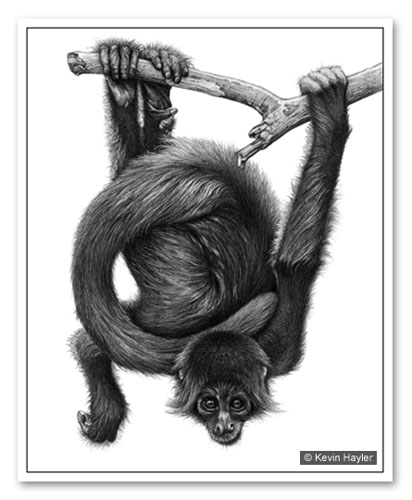
The rules are elementary. You lot draw crisscrossed lines in the management of the fur growth, regardless of its length. That'southward it in a nutshell. That's how I drew the spider monkey above.
The difficulty is in calculation depth. Some lines must exist darker than others if the fur is to look real. You'll detect that some of the darks tend to brand small triangles where two strands of fur see.

Some triangles announced by serendipity as the fur lines cantankerous. Others appear when you lot lighten random areas with a Tombo Mono Eraser Pen (chapter). Y'all take to use your imagination to some extent.
Shorter fur is drawn in the same way, past crisscrossing shorter lines. I created texture on the monkey's head by stippling the pinnacle with Blu-Tack.
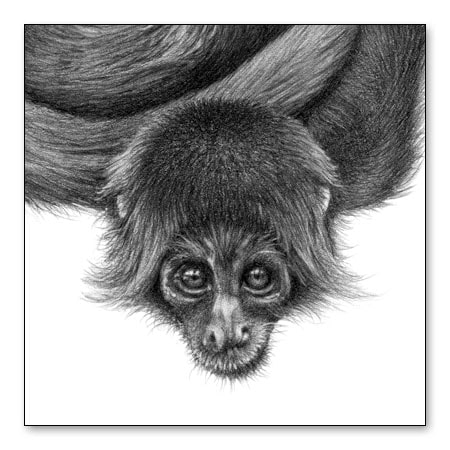
The eyebrows were flicked out using the sharpest edge of a Tombo Mono Eraser (affiliate). The hairs in the top lip were picked out using a Jakar Battery Eraser (affiliate).
If later doing everything y'all tin to make the fur texture to look realistic, and it still lacks something, information technology's often the stray hairs that are missing.
Look at the chin and side-whiskers on the monkey's caput. There are dozens of whispy hairs sticking out. These small touches are all that was needed to make the fur look real.
I'm going to mention one more technique that works if yous do it right but is ruinous if it goes wrong.
Y'all tin can draw fur by indenting the surface of the paper using a edgeless point or indenting tool (affiliate). Yous describe the fur lines by following the growth pattern as if you were using a pencil. With the paper scored by dozens of tiny grooves, you lot use the side of your pencil to shade over the peak.
The indents remain pure white and stand up out against the shading. The effect is immediate, abrupt, and looks impossibly complex. As far as I know, there's no other fashion to get such razor-abrupt white lines.
The drawback, and it'south a big i, is there is no going back if y'all modify your heed. Once it's done, yous accept to alive with it. You can't repair indented paper, so if you draw a wonky line you lot're in trouble. The best you can practice is to draw within the grove with a very sharp pencil and try to disguise it.
This postal service explains: How to Draw White Lines in a Pencil Drawing (Without Going Mad)

I used the indented texture technique on the hogs dorsum above. I used a toothpick to brand the grooves. Yous tin can use any point every bit long as it is clean and not too sharp. If you don't want pure white lines you lot can use a 9H pencil to indent the paper instead.
This flim-flam works, simply in truth, I seldom use this method anymore. I prefer to employ a battery eraser (affiliate) for drawing sparse white lines, that way I tin erase and repair annihilation.
There is another mode of cartoon hair and fur which is much quicker and arguably more effective.
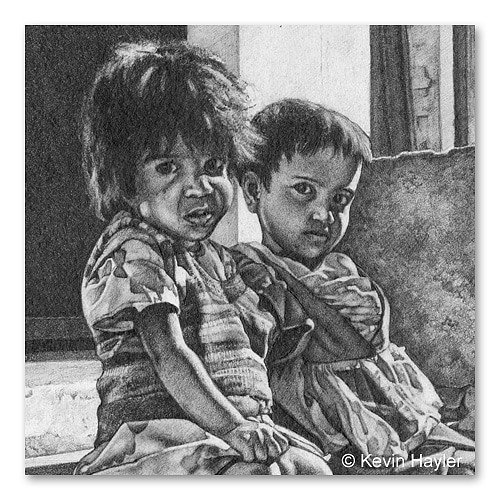
This is a detail of two Indian kids I drew way back in the early on '90s. Information technology was drawn on very fine-grained cartridge paper. I didn't even attempt to depict strands of hair. At that place was no point. I blocked in the shape and with a few flicks of the putty eraser, the hair looks fine.
I seem to have lost the knack of abbreviating my style in the terminal few years, something I'grand determined to remedy.
I like these quick techniques: How to Draw Faster: 14 Adept Tips For Sketching at Speed
6. Drawing Wrinkley Skin Texture
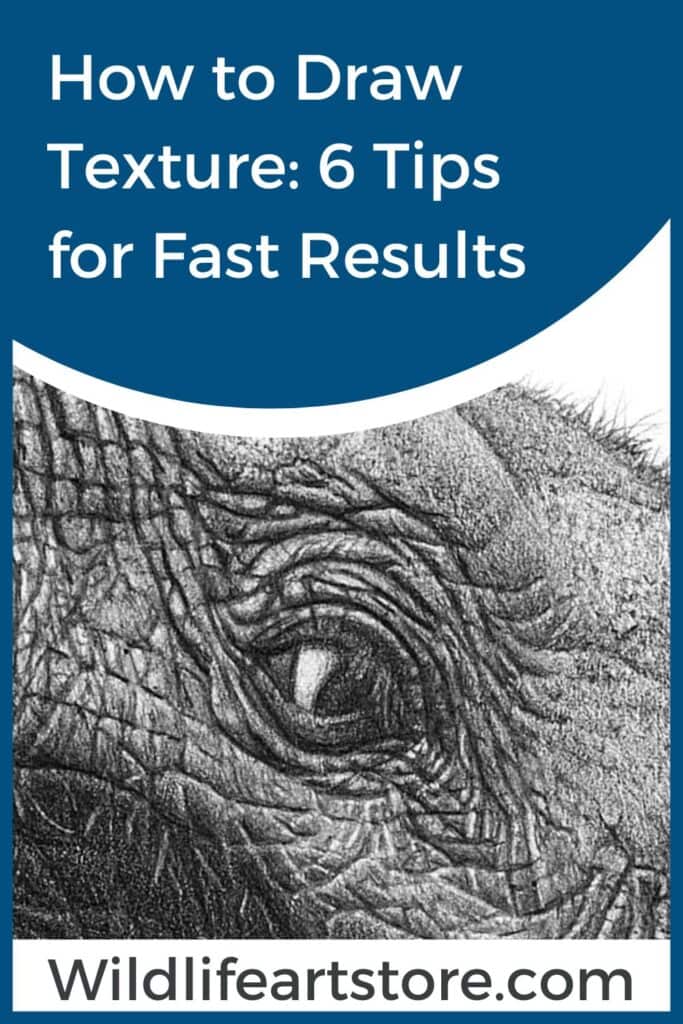
I'll utilize the leathery texture of elephant skin to demonstrate this last technique, merely the aforementioned principles apply when drawing creases and wrinkles with any subject.
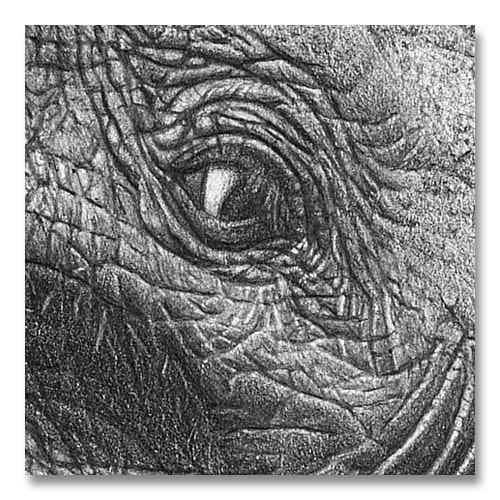
Drawing a contraction is straightforward. First of all, yous draw the line. And so you figure out where the calorie-free is coming from, in this example, information technology seems to be from in a higher place.
The space adjacent to the night line reflects the light, so you accept low-cal confronting dark. A shine transition blends away from the light strip and into a mid-tone and darkens into the side by side wrinkle line.
You tin can erase the contraction highlight with an eraser pen or draw effectually it if y'all're a glutton for punishment. If yous need a clean line, employ the sharpened tip of a battery eraser. If yous chose to indent the line, you'll get a precipitous white edge with no transition.
There's no difference when drawing human wrinkles, the method is the same, only the smoothness is dissimilar. Human being peel needs more finesse and more subtle blending. Use a newspaper blender, smoother paper, or harder pencils.
The leathery skin texture on the elephant's hide is all due to the newspaper grain. Everything was drawn with 0.3mm Pentel Mechanical Pencils (affiliate) and a steady mitt.
seven. Cartoon Texture with Rubbings and Gimmicks
I've read other blogs and they talk almost taking rubbings over wood and brick and using crumpled paper and sponges to press on the paper, simply in all honesty, they accept petty practical application.
Most gimmicks don't piece of work very well. Stick to using erasers.
All you accept to practise is be consequent. If you are hatching in one direction don't spoil the issue past getting lazy and losing the line
It doesn't matter if you crosshatch with diagonals or crosses. Information technology does affair how y'all hatch.
The lines should be roughly parallel and equidistant. Imperfections are fine just a mish-mash of lines volition e'er look non-expert. If you want to hatch in a random zigzag pattern, be neat and tidy. Scribbling seldom works.
Smudging is fine, simply don't use your fingers. It's all likewise like shooting fish in a barrel to go out a grease stain on your paper. Use a newspaper blender, a soft castor, or fifty-fifty a cotton wool bud (affiliate links). Experiment with them. Try tissue newspaper, cotton wool, and chamois leather (affiliate) too. They all blend graphite.
If you lot desire to: Prevent Your Drawings From Smudging: The Ultimate Guide
Drawing Texture – Final Thoughts
Y'all tin can describe textures using very basic art materials. There are no magic wands, no secret sauce, it's only application and practise.
These techniques assistance you to draw texture with a pencil but they're not a substitute for practiced cartoon. You lot must get the proportions, perspective, and composition right showtime.
At present you lot've read this and got a few ideas, become your kit ready and start experimenting.
You'll presently be cartoon texture like a pro.
If you like the way I draw and want to attempt things for yourself, this is my basic kit: (Amazon affiliate links)
- 0.3mm Pentel Mechanical Pencils
- Derwent Graphic Drawing Pencils
- Daler-Rowney Heavyweight Cartridge Paper
- Jakar Battery Eraser
- Tombo Mono Eraser Pen
- Faber Castell Kneadable Eraser
- Blu Tack
- French Box Easel
Now yous're brimming with ideas, what about selling your work besides? If you are stuck and don't know what to do, I can help. Merely have a look!
If You Want to Sell Your Fine art
Check this out!
Psst…it's only $12.99!
You'll enjoy these posts too. Cheque them out:
- Drawing Prompts: 55 Useful Ideas, Techniques, and Exercises
- How to Draw Water: The Rules, Images, & Pro Hacks
- Exercise You lot Need to Outline Drawings? YES and here'southward why…
- How Do You Learn To Draw? 5 Tips To Go You Started
- Tracing Art – Is Information technology Skillful or Bad? When Is Tracing Adulterous and Is It Ever OK?
- What's the Correct Paper for Pencil Drawing? (How to Cull Wisely)
PIN Information technology AND SAVE Information technology

How To Draw Different Textures With Pencil,
Source: https://www.wildlifeartstore.com/how-to-draw-texture-in-pencil/
Posted by: guyloctatintoo.blogspot.com
0 Response to "How To Draw Different Textures With Pencil"
Post a Comment